Adine Kirnberg: Elegant, But Is It Embroiderable?
First Impressions: Ornate on Screen, Demanding in Stitch
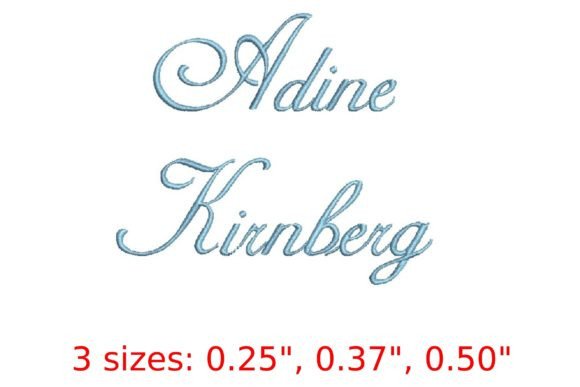
Opening Adine Kirnberg for the first time, I felt that familiar mix of delight and caution. Yes — it’s undeniably elegant. The calligraphic flow, the delicate swashes, the balanced weight between thick downstrokes and hairline terminals — it reads as refined, intentional, and quietly confident. It doesn’t shout. It leans in. That’s exactly why I reached for it when prepping a custom embroidered tote bag for a local teacher boutique’s Back To School launch. But elegance in vector form doesn’t always translate to clean satin stitch on cotton canvas. So I asked myself: does Adine Kirnberg hold up under needle, thread, and real-world wear?
A Real Project Test: Tote Bags, Teachers, and Tiny Details
I digitized a short phrase — “Read. Grow. Shine.” — in Adine Kirnberg at 3.5 inches wide and stitched it onto a medium-weight natural canvas tote. Right away, the design revealed its personality: graceful, yes — but also *deliberate*. The long ascenders and descenders need breathing room. The fine entry/exit strokes? They’re beautiful in theory, but without careful stabilizer selection and tight hoop tension, they feathered slightly on the first run. Not a dealbreaker — just a reminder that Adine Kirnberg isn’t a “drop-in-and-stitch” embroidery file. It rewards attention.
Where It Shines (and Where It Stumbles)
Adine Kirnberg excels in contexts where craftsmanship is part of the value proposition:
- Personalized gifts — baby onesies, nursery pillows, or monogrammed tea towels where the recipient expects heirloom-level detail
- Boutique branding — think hand-stitched labels on aprons or embroidered tags on handmade soap bundles
- Wedding and holiday embroidery — place cards, linen napkins, or keepsake ornaments where ornamental lettering feels intentional and celebratory
- Etsy listings and craft fair products — customers browsing for “handmade typography” or “elegant embroidery” respond strongly to its visual sophistication
But it demands honesty about limitations. On stretchy fabric like cotton jersey (think sweatshirt embroidery or baby bodysuits), those slender stems can distort unless you use cutaway + tear-away combo stabilizer and reduce stitch density manually. On dark fabric, low-contrast thread colors risk losing definition — especially in the finer loops and curves. And forget cramming Adine Kirnberg into a 3-inch hoop for a cap front: the curvature warps swashes, and small letterforms lose legibility fast.
What Your Customers Actually See — and Feel
Here’s what matters beyond technical execution: recognition and trust. When someone sees Adine Kirnberg on a finished product, they don’t just read the words — they register care. That subtle lift in perceived value? It’s real. A customer paying $48 for an embroidered pillow cover doesn’t just want comfort — they want proof that the maker understood nuance. Adine Kirnberg delivers that signal — if executed well. But if the running stitch wobbles or the fill stitch pools in a curve, that same elegance becomes evidence of oversight. So yes: it elevates your handmade product. But only when your process matches its intention.
Practical Designer Notes You’ll Actually Use
Before stitching Adine Kirnberg on your next project, do these six things — not as checklist items, but as habits:
- Test on scrap fabric — same fiber, same weight, same stabilizer stack you’ll use on the final piece
- Check thread color contrast — especially with light threads on light fabric or dark-on-dark combos; try matte cotton vs. high-sheen rayon to see how light catches the curves
- Review stitch density — dense fill areas near junctions (like where a loop meets a stem) can pucker thin fabrics; consider reducing density by 5–10% for breathable textiles
- Confirm hoop size and placement — Adine Kirnberg’s rhythm works best with generous margins; avoid crowding it near seams, pockets, or curved edges
- Inspect small details in black-and-white mockups — what reads as delicate on screen may vanish as a whisper of thread on fabric
- Verify licensing — if you’re selling finished items or digital embroidery files commercially, confirm whether Adine Kirnberg permits commercial embroidery use. Don’t assume.
Fabric & Function: Matching Design to Reality
Adine Kirnberg sings on stable, tightly woven surfaces: linen tea towels, midweight denim totes, twill aprons, and quilting cotton pillow covers. It whispers on textured fabrics like terry cloth or bouclé — those fine strokes get swallowed. It hesitates on thin poly-blends or lightweight rayon unless you add extra stabilizer and slow your machine speed. And for anything meant to be washed repeatedly — baby embroidery, kitchen towels, school uniforms — stick to high-quality embroidery thread and lock those jump stitches. This isn’t a font built for speed; it’s built for resonance.
Final Thought: Sophistication Needs Support
Adine Kirnberg isn’t just another calligraphic embroidery file. It’s a design asset with presence — one that asks for thoughtful pairing, precise execution, and respect for its ornamental language. Used well, it strengthens brand consistency for creative entrepreneurs, adds quiet luxury to personalized gifts, and gives Etsy sellers a distinct visual signature. Used hastily? It highlights gaps instead of grace. So treat it like the considered tool it is: test it, tune it, trust your eye — and let its elegance speak through your craftsmanship, not despite it.